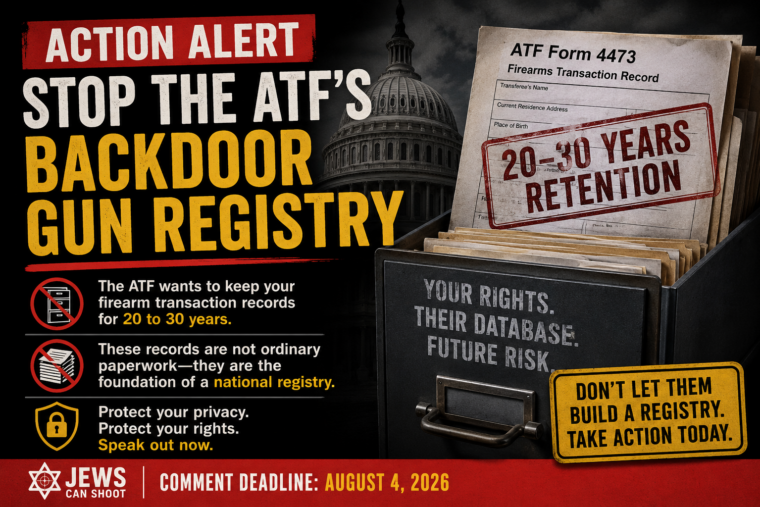
The federal government wants to retain firearm transaction records for decades. Submit your comment before August 4 and tell ATF to destroy the records — not preserve them.
A Message From Jews Can Shoot
Throughout history, governments seeking greater control over civilian populations have often begun with recordkeeping. Lists become databases. Databases become tools for surveillance, targeting, and ultimately disarmament.
Americans should take seriously any effort by the federal government to normalize the long-term storage of lawful firearm ownership records.
The Bureau of Alcohol, Tobacco, Firearms and Explosives (ATF) is currently accepting public comments on a proposed rule titled:
“Firearm Records Retention Periods” (91 Fed. Reg. 24413)
At first glance, the proposal sounds administrative and technical. It is not.
The rule would require federally licensed firearms dealers to retain firearm transaction records for as long as 20 to 30 years. It would also permit ATF to retain out-of-business dealer records after those records are transferred into federal custody.
These records include ATF Form 4473 — documents containing identifying information connected to lawful firearm purchases made by ordinary American citizens.
When firearm transaction records are accumulated, centralized, digitized, indexed, and stored by the federal government for decades, the result is dangerously close to a functional national firearms registry.
Federal law explicitly prohibits the creation of such a registry under 18 U.S.C. § 926(a)(3).
When dealers go out of business, their records do not disappear. They are transferred to ATF storage facilities where millions of records can be retained, searched, cross-referenced, and potentially misused by future administrations.
Law-abiding Americans should not be treated as entries in a permanent federal tracking system simply because they exercised a constitutional right.
History demonstrates why centralized firearm records matter. During the Weimar Republic, firearm registration systems and ownership records were maintained by the government. After the National Socialist regime came to power, those systems enabled authorities to identify and disarm targeted populations, including Jews and political opponents, leaving many defenseless against persecution and state violence.
We must not ignore the lessons of history.
TAKE ACTION NOW
ATF is accepting public comments on this proposal through:
August 4, 2026
Submit your comment here: https://www.regulations.gov/
Avoid simply copying someone else’s statement. Comments are generally more effective when written in your own words.
You may wish to include some of the following points in your comment:
- Federal law prohibits the creation of a national firearms registry.
- Firearm transaction records should not be retained for decades.
- ATF should adopt the shortest retention periods legally possible.
- Records tied to lawful firearm purchasers should be destroyed as soon as legally permissible.
- Out-of-business dealer records should not become permanent federal archives.
- Long-term retention of Form 4473 information creates serious privacy and constitutional concerns.
- Future administrations should not inherit searchable databases of lawful firearm ownership information.
THE BOTTOM LINE
This proposal is about far more than paperwork.
The federal government is attempting to normalize the long-term retention and centralized storage of records connected to lawful firearm ownership.
A government that maintains massive archives of firearm transaction records possesses a tool that can be abused by future administrations.
Jews Can Shoot believes Americans should reject any attempt to create a backdoor firearms registry.
Tell the ATF to destroy these records — not preserve them for generations.