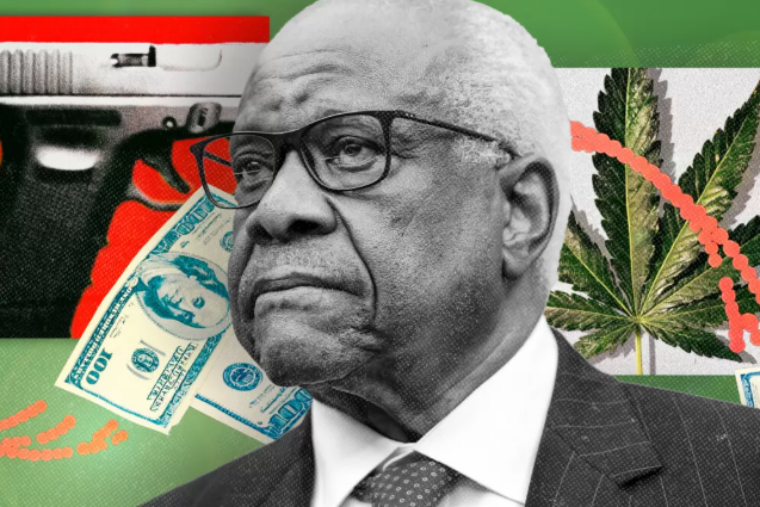
The real significance of Justice Thomas’ concurrence isn’t just about gun rights—it’s about the constitutional limits on federal power. If Congress can regulate virtually anything merely because it once crossed a state line, then the Constitution’s system of limited, enumerated powers loses much of its meaning.
This is a legally dense article, but it’s well worth the time. The final paragraph neatly summarizes its central argument, yet the legal reasoning that leads to that conclusion is what makes the article so compelling. I encourage you to read it in its entirety.
Last week in United States v. Hemani, the Supreme Court unanimously ruled that the government may not strip people of their Second Amendment rights or prosecute them for illegal gun possession simply because they are marijuana users. Justice Clarence Thomas, the longest-serving current member of the Court, joined his colleagues in upholding the Second Amendment rights of cannabis consumers threatened with prosecution under 18 USC 922(g)(3), which makes it a felony for an “unlawful user” of “any controlled substance” to possess a firearm. But Thomas perceived another constitutional problem with that law, arguing that it exceeds the federal government’s power to regulate interstate commerce.
As Reason‘s Damon Root notes, Thomas’ understanding of the Commerce Clause underlies a “lonely crusade” that he has been waging for decades. But the fact that Thomas has not mustered much support for his position from his colleagues does not mean he is wrong. To the contrary, it is hard to deny that laws like Section 922(g)(3), which applies to gun possession “in or affecting commerce,” rely on a highly elastic interpretation of the Commerce Clause that converts it into a license for nearly anything Congress wants to do.
Thomas’ objection to Section 922(g)(3) also applies to other provisions of the same law that categorically prohibit gun possession by broad classes of Americans. Those provisions include Section 922(g)(1), which permanently disarms people who have been convicted of crimes punishable by more than a year of incarceration, and Section 922(g)(4), which covers people who have been subjected to involuntary psychiatric treatment. In fact, all of the categorical bans in Section 922(g) rely on the same dubious justification, purporting to establish congressional authority by criminalizing gun possession “in or affecting commerce.”
By Jacob Sullum